

Live at WRC | How Can One Robot Handle Multiple Scenarios?
At WRC 2026, SFLARE used real-life scenarios to show how embodied intelligence progresses from perceiving the world to understanding people and adapting to environments.
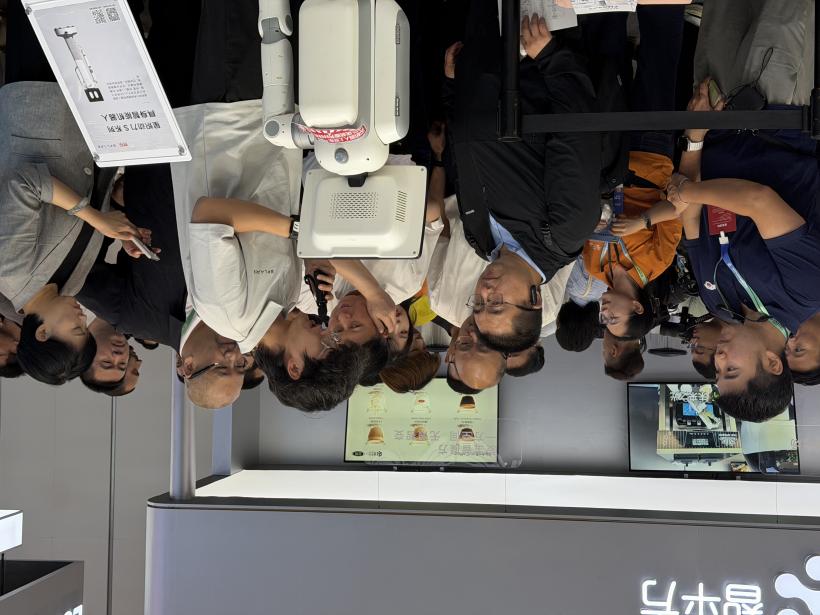
Live from the Show Floor
At the 2026 World Robot Conference, embodied intelligence remained the event's most fiercely contested field.
Yet SFLARE's booth looked more like a miniature living environment. There were no flashy stunt routines—only two embodied intelligent robots demonstrating practical functions designed for real deployment.
Our view of embodied intelligence is simple: the point is not to make a robot look human, but to help it understand and adapt to its environment. Eldercare demands patience and precision, schools need interactive guidance, and businesses value efficient coordination. A unified intelligent foundation makes all of these possible.
Technical Advantages
Cloud–Edge–Device Collaboration: One Robot, Three Brains
In the cloud, the primary PULSE model performs global reasoning, complex decision-making, intent understanding, route planning, and multi-robot orchestration—the robot's commander. At the edge, a quantized PULSE model runs in a local compute center, combining multimodal perception with low-latency decisions. Vision, voice, and sensor data converge in real time, so the robot remains useful without a network connection. On the device, real-time perception models provide immediate feedback and precise control: identifying fall risks, avoiding students running through a campus, and navigating accurately through an office building. Every action is designed to be safe and precise.
From Demonstration to Delivery: Embodied Intelligence Comes of Age
The robotics industry is moving beyond prototype validation into a new cycle centered on delivery and scenario adaptation. A wide gap still separates a perfect laboratory demonstration from stable service in the real world.
Our choices answer how that gap can be crossed:
- Instead of pursuing an all-powerful general-purpose robot, we use a dependable capability foundation that adapts to diverse real scenarios.
- Instead of relying on a single cloud brain, cloud–edge–device collaboration keeps service continuous and reliable.
- Instead of treating the robot as isolated hardware, we embed it in service workflows as an intelligent node connecting people, data, and management.
At WRC, where the world's leading technologies meet, SFLARE may not have delivered the flashiest demonstration, but it raised a question the entire industry should consider.
Once embodied intelligence leaves the laboratory, true competitiveness may not be measured by how many difficult moves a robot can perform, but by whether it can serve ordinary people steadily and reliably in an eldercare corridor, on a school playground, or in a corporate lobby.
That is the real coming-of-age moment for embodied intelligence.