

First Prize at the China–U.S. Young Maker Competition
A joint AI + structural biology + embodied intelligence solution won national first prize in the 2026 competition.
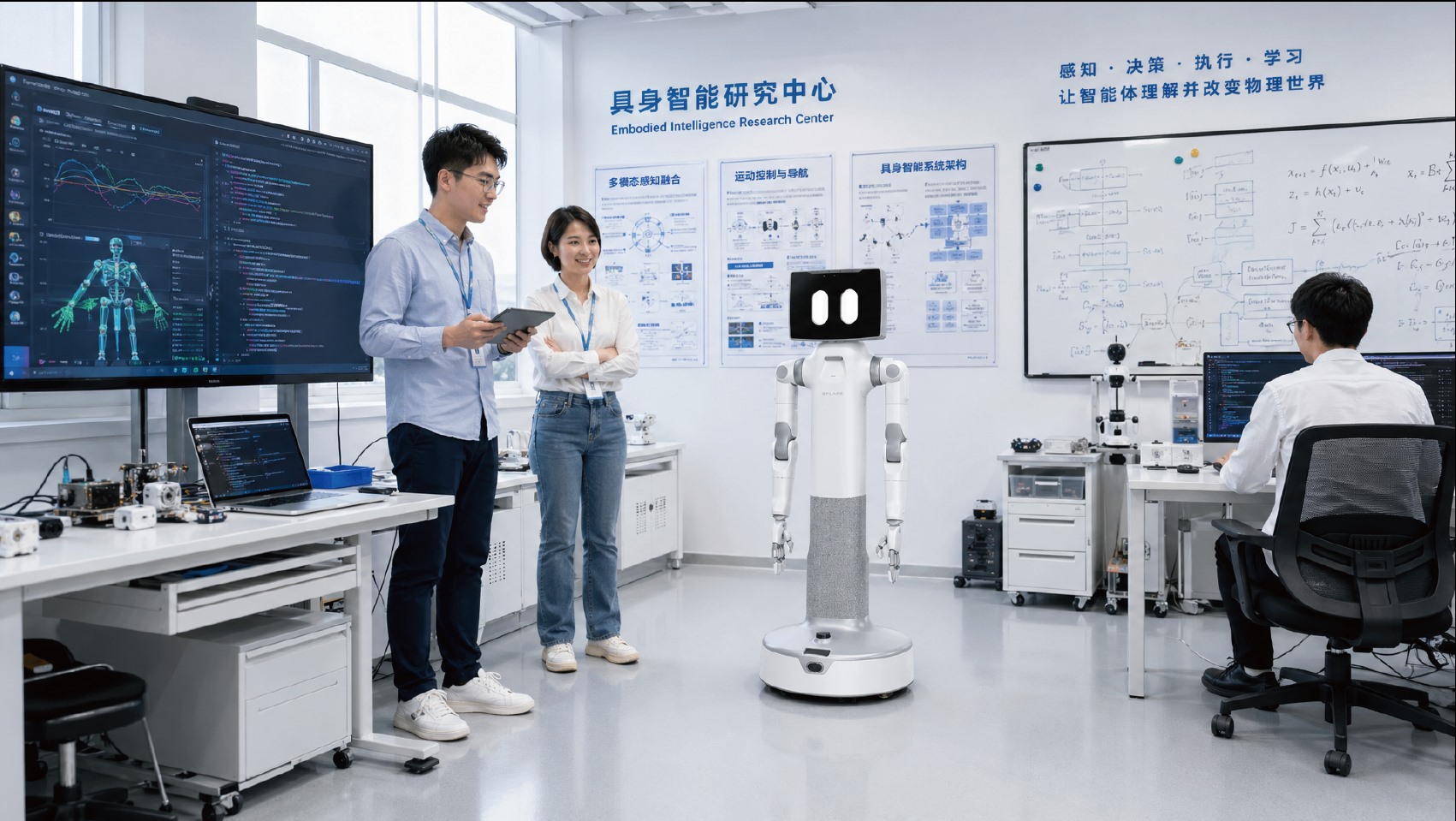
The 2026 China–U.S. Young Maker Competition national finals have concluded. Beijing University of Posts and Telecommunications and SFLARE's embodied intelligent robot won first prize with an interdisciplinary AI + structural biology + embodied intelligence solution.
The competition is an important cross-cultural innovation platform. This award validates not a single technology, but a complete chain—from AI-generated candidate molecules, to real laboratory experiments conducted by a robot, to experimental data returning to improve the model.
Eighty Percent of Laboratory Time Is Spent on Repetitive Work
Peptide-drug research is important to innovative medicine, but experiments remain a bottleneck. AI can design thousands of molecular structures in a day, while manual pipetting, dosing, reaction, and testing are repetitive, precision-intensive, and dependent on experience. Validating one candidate can take weeks.
The missing piece is not another algorithm, but a physical execution terminal that brings algorithms into the real world. That is the gap SFLARE's embodied intelligent robot fills.
An End-to-End Chain from On-Screen Molecules to Test-Tube Reactions
The solution covers target analysis → AI molecular design → computational screening → experimental validation → feedback optimization.
Building on a national key R&D program for AI-guided biosynthesis of complex drugs, the BUPT team uses a multisource biomedical knowledge base, generative AI, and multi-agent drug-design models to generate candidate peptide molecules and predict their structures.
The SFLARE robot acts as the physical execution terminal, converting computational instructions into precise pipetting, sample handling, reaction monitoring, and data return—closing the loop from digital simulation to physical experiment.
The university model decides what molecule to design; the robot makes it in the laboratory. Experimental data flows back to the knowledge base and model. This is a deep coupling of intelligent design and physical execution in a real R&D process, not a loose combination of software and hardware.
One General-Purpose Platform Lowers the Barrier to Interdisciplinary Validation
The award validates not just a peptide-drug workflow, but SFLARE's value as an interdisciplinary validation platform.
For universities and research institutes, this means:
- No need to reinvent the wheel: teams can focus on scientific questions instead of building laboratory automation from scratch.
- Rapid scenario switching: AI, biomedicine, and intelligent manufacturing teams can validate work on the same robot, reducing hardware costs.
- Reproducible, transferable results: production-grade quality control supports stable operation and provides a hardware foundation for commercialization.
With a stable, open, readily connected embodied-intelligence platform, innovation is limited by imagination rather than hardware.